Understanding healthcare info: What are you talking about?

Healthcare information in our everyday lives often falls short of helping people understand their conditions and how to treat their ailments. The same is true for broader health care system information, including lab results and prescription scripts. How often have all of us witnessed inscrutable billing statements and confusing dosing terminology?

It should be a tenet of healthcare communications that they be understood by sixth graders. Why is this so important? Because health literacy is not universal and by failing to compensate for it, our healthcare system undermines access to good care. We cannot help patients if they cannot understand their providers. When the average patient doesn’t know the basics about his condition, the actions to take to spur recovery or maintain health, and what care he must purchase to attain health, the whole system is flawed.

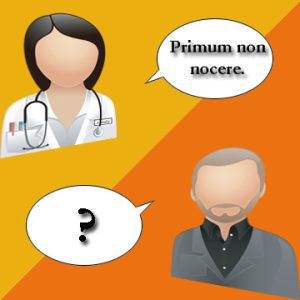
Doctor speaks in Latin and patient replies "what?"

Imagine if you went to your mechanic and he failed to explain in common terms why your car wasn’t working and failed to suggest a repair that was equally mysterious. Imagine if he gave you a bill that failed to describe what the repair was and also neglected to give you concrete advice on how to keep your car in working order. No one would put up with this. So should we accept this kind of failure for something as important as our healthcare? Of course not.
This situation is worse for those who are intimidated by the medical establishment, who must muster the courage to demand clarity from their providers. And  those who speak English as a second language may be embarrassed or ashamed to admit not understanding their doctor. When considering how to reform our healthcare system, one major change should include making healthcare communications—from prescription instructions to medical invoices—more accessible to people of all levels of literacy.
Once patients learn the true cost of their healthcare, they can make better shared decisions about their care with their doctors. They would become more empowered patients who could gain a better grasp of how they have been treated. They would understand better their role in reaching and maintaining their health, all the while knowing what they paid for it. At its core, occupying healthcare means making the patient the center of all reform decisions. That can only happen if the patient knows what is going on.

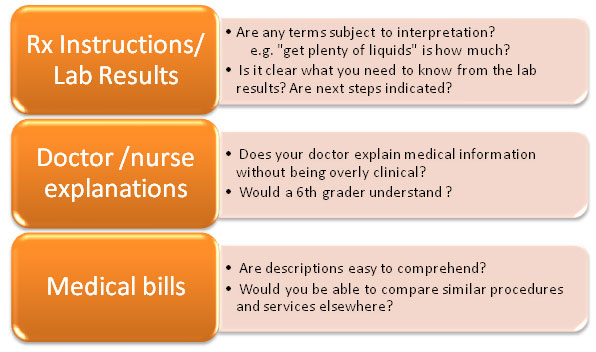
The Comprehensibility Acid Test

Let us set the bar high. Until all our healthcare communications pass the test below, we should continue to occupy healthcare for change.
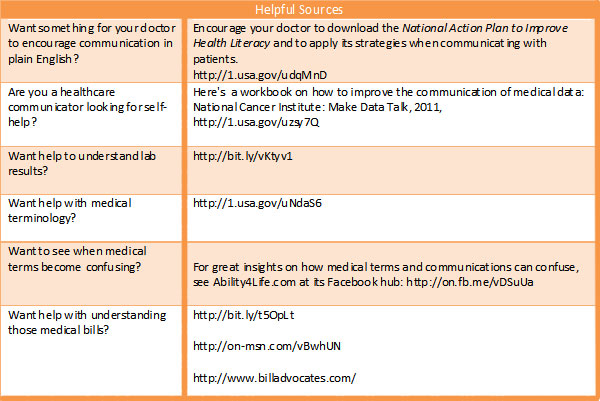
Helpful Healthcare Sources

Tagged with: ,
Posted in Community, Health behavior, healthcare, medical education, Social Determinents of Health
4 Comments » for Understanding healthcare info: What are you talking about?
  1. If you have not heard of Thomas Goetz (an editor for Wired magazine who also has an MPH), he has a great TED talk on this issue: http://www.ted.com/talks/lang/en/thomas_goetz_it_s_time_to_redesign_medical_data.html

    It’s not just about teaching/training patients to understand the current output, but to alter the output altogether so that it’s easier to understand (or convey important information) for all parties.

    He outlines potential changes for blood test results, pharmaceutical marketing adjustments to incorporate the “Drug Facts Box” created by physicians at Dartmouth, and gives patients questions to begin forming their own feedback loop.

    I discuss it to some extent in my own blog here: http://owningmyhealthcare.blogspot.com/2011/02/what-can-i-do-to-begin-demanding-more.html

    • crgonzalez says:

      Thanks Michael for your comment. As I hoped you gathered from the post, there are several parts to improving understanding of healthcare info. There’s often little need to be overly clinical when conveying healthcare information, and when recognizing the low literacy rate of our society, it is important for health care providers to speak plainly. If such a mandate for health professionals were codified (e.g. no 14-page informed consent forms, use Flesch-Kincaid levels not exceeding 6th grade comprehension, etc.), then we’d probably get somewhere. Without that push, all change is piecemeal at best.

      • Terms that are subject to interpretation, like “get plenty of fluids” tend to have an extensive amount of variability associated with them: height, weight, exercise, etc. To quantify those types of statements would be an educated guess on behalf of the clinical provider, would it not? I completely agree with the other points.

        • crgonzalez says:

          The point about “plenty of liquids” is that a discussion about vague terms needs to take place between the physician and the patient. Leaving that instruction solely in the hands of the patient, who may not have any idea as to what that means in the context of a medicine prescription is reckless. Inquiries about how much fluid is typically taken during the day, how much physical activity may influence fluid intake, etc. are the sorts of discussions that should precede a medicine bottle’s admonition to “drink plenty of water.” It may be the case that the patient hasn’t been drinking enough water, but the doctor will never know unless the question is posed. Never assume a patient knows what any ambiguous term means.

1 Pings/Trackbacks for "Understanding healthcare info: What are you talking about?"
  1. [...] I haven’t spent much time on the site yet, but here is the inevitable OccupyHealthcare. One thing they’re talking about is health information and responsibility for health literacy. [...]

Leave a Reply

Your email address will not be published. Required fields are marked *

*

You may use these HTML tags and attributes: <a href="" title=""> <abbr title=""> <acronym title=""> <b> <blockquote cite=""> <cite> <code> <del datetime=""> <em> <i> <q cite=""> <strike> <strong>

Occupy Healthcare on Twitter
Bill_GardnerBill_Gardner: RT @miller7: One reason why academics (and others) should be involved in social media via @Bill_Gardner #occupyhealthcare http://t.co/6X1KLKJs
3 hours ago from Twitter for Android
ShahinaLakhaniShahinaLakhani: Calling The Simbas Of World http://t.co/xwxiDIg3 #Occupyhealthcare #nuseup #AmandaTrujillo #carechat #RNchat #selhelp #Empowerment #Nurse
12 hours ago from HootSuite
kaycey55kaycey55: RT @nursefriendly: @kaycey55 We are linking to #occupyhealthcare #propublica #motheragainstmedicalmistakes and other groups that are voicing concerns #rnchat
15 hours ago from TweetDeck
nursefriendlynursefriendly: @kaycey55 We are linking to #occupyhealthcare #propublica #motheragainstmedicalmistakes and other groups that are voicing concerns #rnchat
15 hours ago from TweetDeck